
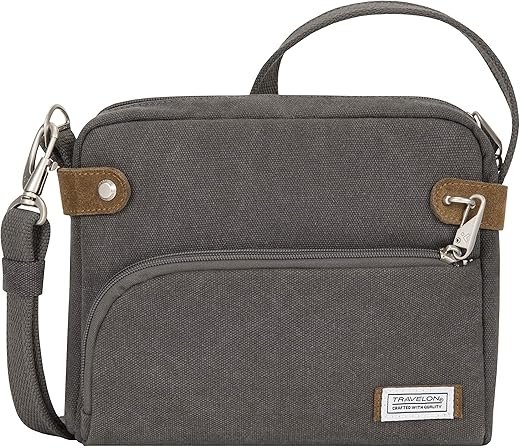
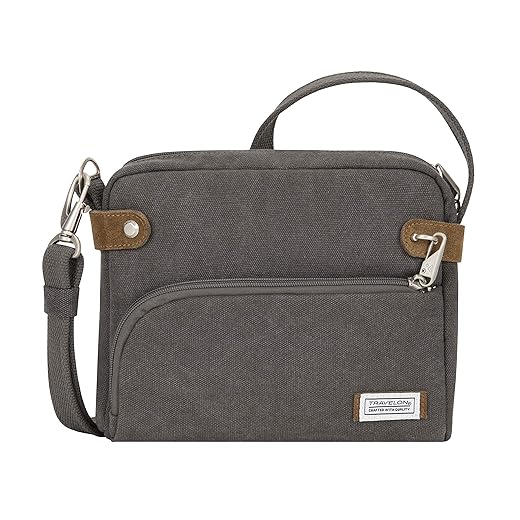
Travelon Anti-Theft Heritage Small Crossbody Bag
- SAFTY AND SECURITY ARE IN THE BAG with 5-Point Anti-Theft features like hidden slash resistant stainless steel mesh body panels, locking zippers, adjustable stainless steel cable strap that can be attached to a stationary object to prevent a grab-n-go
- IT ONLY GET'S BETTER WITH AGE, beautifully crafted designed in cotton & canvas material with suede trim, accented in nickel plated hardware
- LIGHWEIGHT & PRACTICAL with plenty of storage to keep your items organized. You can wear it over your shoulder or crossbody for hands-free convenience
- EXCELLENT SIZE FOR ANY OCCASION featuring front zip and rear slash pockets, 2 open top wall pockets and a tethered key clip and a zippered RFID protected wall pocket
- Product Size: 9.5"W x 8"H x 2.5"D, Strap Drop Length: 13" – 25", Strap Length: 53", Weight 0.9 lbs

Travelon Anti-Theft Classic Messenger Bag
- ADVANCED 5-POINT ANTI-THEFT PROTECTION — Travelon’s patented security system creates a powerful, invisible shield between you and the unexpected. Locking zippers, slash-resistant mesh body panels, dual cut-resistant strap cables, and RFID-blocking slots and drop pockets, and a lockdown strap work together to safeguard your belongings from both physical and digital theft. Trusted by millions of travelers worldwide.
- SMART ORGANIZATION RESTORES ORDER — Life is chaotic, your bag shouldn’t add to it. Intuitive, purposeful organization creates calm, and keeps essentials where you expect them to be. A front zippered pocket for quick-grab items; rear zippered pocket has RFID card and passport slots. Locking main compartment has 2 drop pockets, a zippered pocket, tethered keyclip and 2 water bottle pockets. It functions like a personal assistant—so you stay focused, efficient, and ready for anything.
- ULTRA-LIGHTWEIGHT + ERGONOMIC COMFORT — Classic bags are designed to ...

Leather Crossbody Bag for Women Small Anti Theft Messenger Purse | RFID Blocking,Safety Zipper,10 Card Slots,Removable Straps,Multi...
- Perfect Size : 7.09" (L) x 3.15" (W) x 8.27" (H), weights 1 lbs, adjustable leather strap length 39.37~48.43inches,Boho strap length 33.9~52inches.
- Anti-Theft & RFID Protection:The main pocket is equipped with a snap-fastener, while the front pocket features a secure magnetic buckle and zipper closure for double protection.
- Multiple Compartments: The crossbody bags for women features 2 zippered pockets, 2 insert pockets, 10 card slots, 1 rear pocket and a key leash.
- Wide Open Design: Conveniently and quickly place your phone, wallet, sunglasses, keys and other necessities neatly organized and easily accessible.
- All Occasions:Perfect for all weather, this leather purse for women is suitable for for everyday going out, travel, errands, or weekends. A good gift for Daily / Party / Homecoming / Dating / Night Out / Halloween / Christmas / Thanksgiving / New Year / Valentine's Day / Office Work / Business / Lounge / Travel / Jogging / Outdoors...
Security matters most when a bag has to work in motion.
A packed train closes its doors; a café chair leaves a purse behind its owner; a shopping queue compresses personal space. These are the moments when access and exposure compete: a bag must open easily for a transit card or phone, yet not offer an unnoticed hand a simple route to a wallet.
Anti-theft construction reduces opportunities rather than guaranteeing safety. The useful starting point is the routine: standing-room commutes, tourist crowds, table-side stops, or hands-free shopping. A crossbody worn close to the torso changes access; locking zipper pulls slow casual interference; slash-resistant panels and straps address a different threat altogether. Features matter only when they suit how—and where—the purse is carried.
- RFID-blocking pockets are relevant only for RFID-enabled payment cards or passports; they do not prevent physical theft.
- A chair-friendly purse benefits from a strap that can be secured around a fixed object, while transit use often favors compact, body-facing carry.

Three anti-theft purse fits
Physical-access theft
Opening a bag, cutting into it, or removing it from its carrier. It is most relevant in packed transit, queues, and close-contact settings.
Card skimming
Reading data from an enabled contactless card at short range. It is distinct from theft of the physical card or phone.
Deterrence
Features that make a quick, unnoticed attempt harder, such as lockable zipper pulls or a bag worn across the body.
Recovery tool
An aid after loss, such as a tracking tag or visible contact information. It does not prevent access in the first place.
Layered protection
Several independent obstacles aimed at the same likely threat, so one defeated feature does not end the bag’s protection.
Match the bag to the threat most likely to occur
-
Map ordinary stops and transitions
Crowded platforms, café seating, hotel lobbies, and hands-busy moments create different opportunities. Most routes call for one or two priority defenses, not every available feature.
-
Treat access control as the primary layer in dense crowds
Lockable zippers can slow casual opening; a tether can complicate grab-and-run theft from a chair. Check how secure zipper pockets are constructed, since a lock matters little if the compartment is easy to reach or the pulls separate.
-
Read cut resistance precisely
A reinforced strap may resist a quick slash, while a cut-resistant body panel protects only the panel it covers. Neither stops forced opening, nor does either make a bag impossible to take.
-
Use RFID blocking only for the card concern
A shielded pocket can reduce contactless-reading exposure when cards are inside it. It cannot protect cards carried elsewhere, prevent card theft, or secure phone-based payments.
-
Add recovery without mistaking it for prevention
A discreet tracker may help locate a missing bag when its signal can be detected, but it adds no barrier to a thief. Keep essential documents and backup payment access separate from the purse.
A zipper lock and tether create delay during an attempted theft. Reinforced materials add resistance to specific cutting attacks. RFID shielding addresses a narrow electronic risk, while a tracker supports possible recovery afterward. Meaningful protection comes from combining the layers that match the route—not assuming one feature covers every failure point.
Security works only when the bag stays easy to manage
- A capacity limit that preserves closureA tightly packed purse strains zippers and encourages a phone or wallet to ride in an outer pocket. Choose space for the normal load plus a small margin, not a cavern that hides essentials.Look forMain compartment closes without force when fully loaded.AvoidOverstuffed bags that leave zippers partly open.
- An opening that faces the wearerTop or body-side access can be monitored more naturally than a wide, outward-facing opening. The closure should be reachable with one hand while the bag remains in front.Look forA zipper path visible when the bag is worn forward.AvoidDeep openings that expose contents during every search.
- Stable fit and manageable weightA broad, adjustable crossbody strap helps keep the bag high and close rather than swinging behind the hip. Heavy hardware and a loaded organizer can make a secure bag less likely to stay in that position.Look forA strap range that holds the bag at the front hip or torso.AvoidA loose, heavy bag that migrates behind the wearer.
- Intentional pocket placementFrequently used items need quick, visible access; passports, spare cards, and keys benefit from interior or body-side pockets. A tracker pocket is useful only if it is discreet and does not replace a closure.Look forSeparate zones for transit items and valuables.AvoidOne catch-all compartment requiring prolonged rummaging.
Travelon Heritage Small Anti-Theft Crossbody Bag
Best for secure everyday travel with classic styling
This compact canvas-and-suede crossbody is built for lighter daily carry and sightseeing: phone, wallet, passport, sunglasses, tickets, keys, and a small power bank. Its adjustable strap supports close-to-body wear, while the classic styling is unobtrusive enough for commuting as well as travel.
It is less suited to a full day’s gear. A water bottle, tablet, camera, packable layer, guidebook, or bulky charger can quickly make a small crossbody crowded or awkward to access.
- Five-point anti-theft design
- Locking compartments and strap
- Slash-resistant body panels
- RFID-blocking zip pocket
- Useful pocket separation
- Small main compartment
- Bulky gear crowds access
- Canvas needs more care than technical nylon
- Locks add a step at every opening
In brief A notably well-layered compact option for essentials that need orderly, close-to-body carry. Capacity is the trade-off: it works most naturally when the load stays deliberately lean.
The Heritage Small combines locking access, slash-resistant construction, a locking strap, and an RFID-blocking pocket in a bag that does not look overly technical. It is a strong match for essentials-only travel days and routine urban carry. Those needing room for a bottle, extra clothing, or larger electronics may be better served by a larger crossbody or day bag.
Travelon Classic Anti-Theft Messenger Bag
Top choice for roomy organization and reinforced protection
This larger messenger suits day trips that call for a tablet, paper guidebook, light layer, charger kit, and the small purchases that accumulate between stops. Its layout rewards a deliberate packing order: frequently used items near the top, heavier gear close to the body, and valuables in the locked sections. The trade-off is visibility—when filled to capacity, a messenger looks and behaves more like luggage than an unobtrusive purse.
- Roomy compartmentation separates tech, guidebook, and daily extras.
- Locking zippers can keep the main access points closed during crowded transfers.
- Cable-reinforced strap and lockdown feature add resistance to grab-and-go situations.
- Expansion pockets keep a bottle or glasses from displacing protected contents.
- A full messenger is heavier and more conspicuous than a compact crossbody.
- More pockets create more closure points to check after each retrieval.
- Tablet, layers, and chargers can make the bag bulky against the hip.
- Large loads may encourage leaving a compartment partly open for convenience.
The Classic Messenger brings meaningful carrying capacity to an anti-theft format, with locked access and reinforced components supporting a fuller itinerary. Packing discipline is part of its security: overstuffing slows item retrieval, hides an unlatched zipper, and makes the bag harder to keep close in dense crowds.
For travelers who routinely carry a tablet and outer layer, the extra space can be worthwhile; for essentials-only outings, a smaller close-body bag may stay easier to monitor.
Leather Small Anti-Theft RFID Crossbody Purse
Best for budget-minded shoppers wanting organized storage
This compact crossbody brings a fashion-led, highly compartmentalized layout to a lower-cost tier: ten card slots, multiple pockets, a rear pocket, and a key leash can keep small daily essentials from pooling in one open cavity. Its modest dimensions also suit errands, events, and travel days when a phone, cards, keys, and glasses are the whole load.
The listing’s “anti-theft” wording merits a closer read rather than automatic trust. Before relying on it for transit or crowded sightseeing, confirm whether the strap contains a cut-resistant cable, whether any body panels are reinforced, what metal and attachment points the zippers use, and whether the RFID claim applies to a defined card pocket or the entire bag. Material and hardware details can vary by listing variant.
- Compact organization without a bulky profile
- Ten card slots and key leash
- Layered closures on stated pockets
- Adjustable, removable strap options
- No stated slash-resistant strap or panels
- Snap and magnetic closures are not locks
- RFID coverage needs listing confirmation
- Leather and hardware specification is limited
This purse can make sense when organization, compact carry, and a modest spend matter more than a fully specified security system. Its zippered storage and layered pocket closures add friction to casual access, while the card slots reduce the need for a separate wallet.
It is more accurately treated as a stylish crossbody with selected protective features than as verified anti-theft gear. A purchase decision hinges on the exact variant’s reinforcement, strap construction, zipper hardware, and stated RFID-pocket coverage.
Choose a shape that stays in view
A crossbody usually offers the most stable close carry: the strap crosses the torso, keeping the bag from swinging and placing its opening near the front hip or waist. For secure everyday crossbody access, select a strap length that lets the bag sit in sight rather than behind the body.
A messenger carries more but can pull outward when overloaded; its flap and broad profile also make quick visual checks easier. A shoulder bag is convenient indoors yet less stable in crowds, where it can slide behind the arm. Backpack-style purses spread weight well, but rear openings are harder to monitor; front-worn carry or a side-access design reduces that blind spot.
For all-day use, check that the strap lies flat, the bag does not rotate while walking, and the main zipper can be reached without removing it.
Make the security features part of the routine
-
Protect the irreplaceable items
Use the deepest lockable or most concealed compartment for a passport, payment cards, and backup identification. Keep RFID cards within the shielded pocket only when its coverage is clearly verified.
-
Give keys a fixed anchor
Clip keys to an internal tether or key ring where available; a loose key bundle can vanish into a crowded bag at the worst moment.
-
Treat exterior pockets as convenience space
Reserve quick-access sleeves for low-value, replaceable items such as tissues, a transit receipt, or a reusable bag—not a phone, wallet, or travel document.
-
Load it as it will be carried
With daily essentials inside, close every zipper, flap, and locking pull one-handed. Overstuffing can prevent closures from fully engaging and makes security checks easier to skip.
-
Build one repeatable reset
At the end of each outing, return essentials to their assigned zones. This simple routine complements a women’s everyday-carry guide by making missing items noticeable sooner.
What alarms, trackers, and tethers can do
An alarm attachment can create a loud interruption when pulled or activated, potentially drawing attention during a grab. Its value depends on accessible placement, charged power, and a pull tab that will not snag during ordinary movement.
A tracker is primarily a recovery tool: location updates may be delayed, imprecise indoors, or unavailable if its battery fails. A tether can slow a quick removal of keys or a wallet, but it may also add snag risk and should not obstruct a bag’s closure.
Anti-Theft Purses: Common Questions
Does RFID blocking stop someone from stealing my purse?
No. RFID-blocking pockets are relevant only for RFID-enabled payment cards or passports carried inside that specific pocket; they do nothing to prevent physical theft of the bag or its other contents.
Is a locking zipper enough if I wear the bag behind me?
No, carry position remains a major part of deterrence. A lock delays access, while a front-worn bag improves both sight and touch awareness. Hardware cannot compensate for a bag sitting in an unmonitored position behind the body.
What does a slash-resistant strap actually protect against?
A reinforced strap may resist a quick cutting attempt aimed at severing it, while a cut-resistant body panel protects only the panel it covers. Neither feature stops forced opening through a zipper or closure, and neither makes a bag impossible to take.
Can a tracker on my purse prevent theft?
No, a tracker is primarily a recovery tool. Its location updates may be delayed, imprecise indoors, or unavailable if the battery fails, and it adds no physical barrier to a thief in the moment. It works alongside prevention measures, not in place of them.
These additions work alongside a closed, front-carried purse and situational awareness—not in place of them. For alarm setup details, see the focused guide below.
-
Identify the likely threat
Pickpocketing, strap cutting, card skimming, and loss call for different protections.
-
Verify the protection
Check documented panel and strap reinforcement, RFID-pocket coverage, and the locking mechanism.
-
Work the closure
The zipper, flap, and lock should operate easily while the purse is worn.
-
Load the real contents
Essentials should fit without strained seams or a compartment left partly open.
-
Inspect the carry system
Confirm strap adjustment, anchor stitching, hardware quality, and stable front carry.
Choose Protection That Gets Used
The strongest choice is rarely the purse with the longest feature list. It is the model whose documented reinforcement, closure sequence, capacity, and carry position suit the actual routine—making secure habits easy to maintain when moving quickly.





2 Comments
I always assumed RFID blocking meant the whole purse was protected. Is it usually just a specific card pocket? I carry my wallet in different spots depending on how much stuff I have, so that seems important.
That’s an important distinction. On most bags, RFID protection applies only to a labeled RFID-lined pocket or compartment, not every pocket in the bag. Keep contactless cards and a passport, if applicable, inside that documented protected area; the rest of the bag is mainly about physical access and organization.