
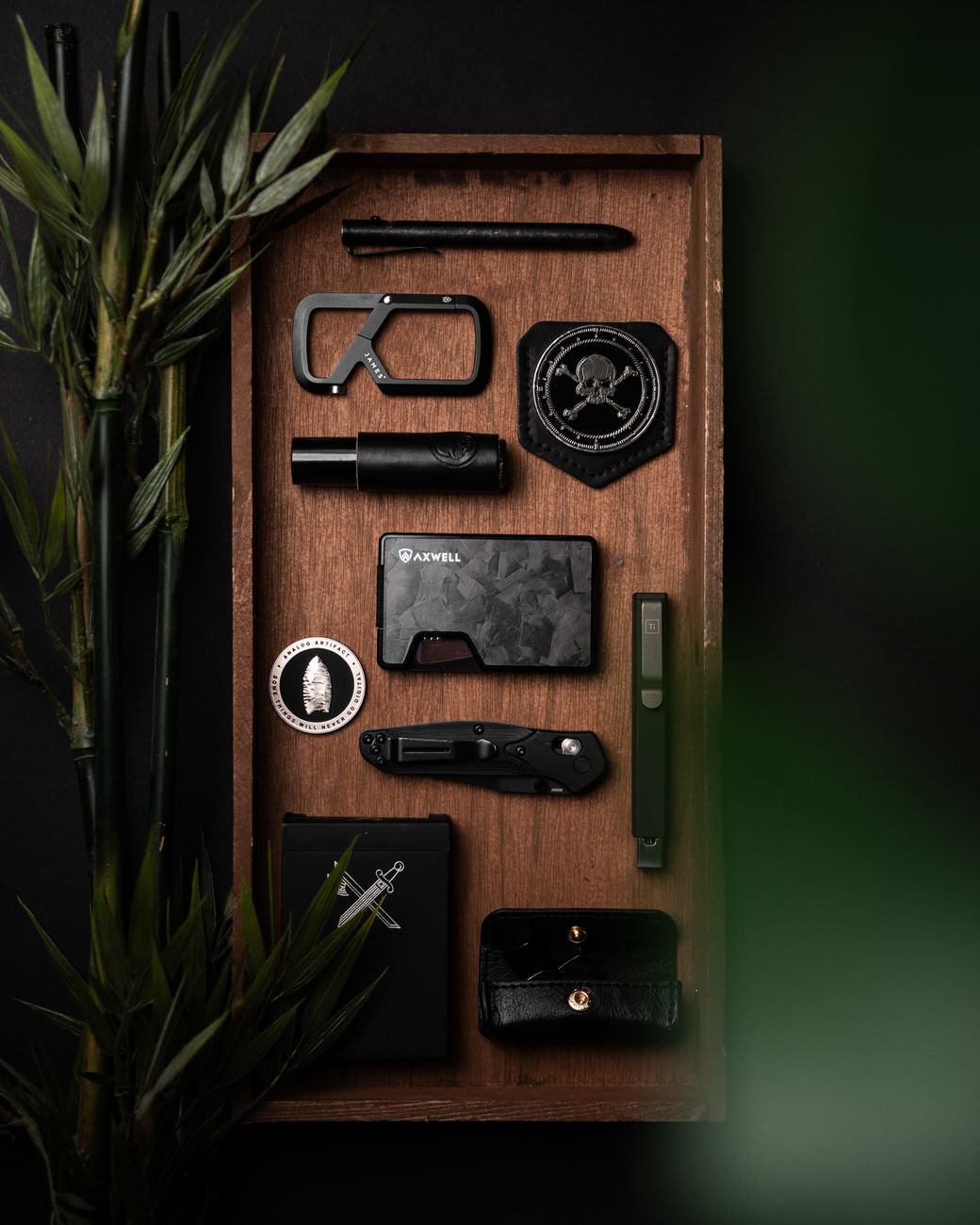
Counter clutter usually begins in the ten seconds after the door closes.
Keys hit the counter, a pocketknife lands beside the mail, earbuds trail their charging case, and a flashlight rolls toward the fruit bowl. By morning, these objects look like clutter—even when each one earns its place during the day.
The issue is rarely an oversized EDC collection. It is the missing handoff point between pocket and home: a spot that makes unloading faster than abandoning items on the nearest flat surface. Good organization starts by treating the pocket dump as a repeatable transition, with a defined landing place for daily carry, charging gear, and items that need attention before the next outing.
- Separate daily-return gear from items that only pass through pockets, such as receipts, packaging, and borrowed objects.
Sort gear by how it actually lives
A storage plan starts with a quick count, not a shopping cart. Gather gear from pockets, bags, drawers, vehicles, and the current counter pile. Then assign each item a role based on its use over the last month. This informs the EDC storage organization system.
- Daily carry: items that leave home most days—wallet, keys, flashlight, multitool, notebook, or earbuds.
- Rotation: alternatives used for changing tasks, clothing, weather, or preference.
- Maintenance: chargers, batteries, bit sets, cloths, lubricants, and spare parts.
- Backup: duplicates held for replacement, travel, or infrequent needs.
- Display: pieces kept visible for enjoyment, collecting, or easy comparison.
This separation exposes misleading “daily” categories. Five flashlights may be owned, for example, but only one may need the landing tray; the others belong in a rotation drawer or labeled case. Maintenance gear also needs its own home, since a battery charger parked beside a daily flashlight creates the appearance of clutter even when both are useful.
Apply a simple visibility test: an item earns counter or open-shelf space only when seeing it supports a routine, a decision, or genuine enjoyment. Everything else can remain protected but accessible. For a closer look at when gear belongs on display rather than in storage, consider dust exposure, sunlight, security, and how often the piece is handled.
Count the resulting groups before choosing containers. Storage capacity should follow the largest realistic rotation—not the collection’s future possibilities.
Build a landing zone that stays small
Additionally, a landing zone is not a storage surface. It serves as a short-term transfer point for items in rotation: phone, wallet, keys, watch, pocket tool, and a flashlight. This setup supports an EDC storage organization system.
Contain movement, not just objects
Choose a shallow container with a grippy base and raised edges. Rubber, cork, silicone, or felt-lined surfaces reduce the small slides that turn a tidy tray into scattered gear; a comparison of valet trays that keep gear from sliding can clarify which materials suit heavier metal items. Avoid deep bowls: buried objects slow the departure routine and encourage duplicate purchases.
Each object needs a visible parking position. A watch rests on a soft pad, keys occupy one corner, and charging cables route to the rear so their connectors do not cross the tray. If an item cannot be located at a glance, its place is not defined enough.
Set a hard capacity limit
In an EDC storage organization system, the tray holds the current loadout plus items charging.
When a new item enters, one item must leave for rotation or maintenance.
Anything left after a day is no longer landing; place it in drawer system, where each piece has a home.
A useful limit is one layer only: no stacking, no loose mail, no packaging, and no backup gear. A full tray is a signal to reset it, not permission to annex more counter space.
Give overflow a working home
Overflow gear needs a home that is easy enough to use, but not so prominent that it migrates back to the counter. The useful dividing line is retrieval frequency: weekly-use items benefit from fast, visible access; rarely used or delicate items can tolerate a more protective container.
Make drawers do the quick-access work
A shallow drawer suits spare batteries, bit sets, multitools in rotation, charging leads, and small maintenance supplies. It keeps the collection searchable at a glance without giving every item counter real estate. Before choosing inserts, measure usable clearance—drawer floor to the lowest point of the closed drawer or slide hardware—not merely the drawer-front height. Also measure around obstructions, then leave a little room for liners and items that are thicker at one end.
A low-profile drawer organizer sized for real internal clearance prevents compartments from becoming loose catch-alls. Group by task rather than by material: one compartment for light maintenance, one for power and charging, one for field repairs.
Reserve cases for protection and low-frequency gear
An adjustable case earns its volume when contents need separation, cushioning, or transport. Divider cases work well for electronics, specialty tools, spare optics, and project-specific kits that leave storage together. A configurable compartment case for protected storage also makes it easier to reconfigure the layout as a kit changes.
- Shallow drawer: fastest access; limited depth and impact protection.
- Adjustable case: more bulk; better containment and item-to-item separation.
Label cases by the task they support, such as “bike repair” or “power outage,” rather than by a vague inventory list. That preserves retrieval speed even when the collection grows.
Use vertical space without crowding the room
A counter is a work surface, not a warehouse. Moving secondary gear onto a nearby vertical plane keeps the daily landing zone clear while leaving frequently handled items within reach.
Match the surface to the load
Cabinet interiors suit thin, light items: microfiber cloths, charging leads in small pouches, spare clips, or maintenance supplies. A closet side panel can take a narrow rail, hook strip, or hanging organizer for bags and seldom-rotated accessories. Walls are useful for visible, quick-grab gear, especially when each hook or pocket has a defined item rather than becoming a catch-all.
For rentals, removable wall organizers designed for light gear can add useful capacity, but their stated rating depends on a clean, suitable surface and even loading. They are not a substitute for hardware-mounted storage.
A pegboard, rail, or shelf holding tools, larger lights, loaded bags, or dense organizers needs fasteners matched to the wall construction. Stud-mounted screws or appropriate anchors distribute load far more reliably; a properly secured pegboard installation also prevents gradual loosening from repeated removal.
Keep clearance in mind: cabinet doors must close, closet doors must slide freely, and mounted gear should not protrude into a walking path.
Treat adhesive hooks and strips as lightweight, low-consequence storage. Temperature swings, textured paint, and repeated tugging can reduce their hold. Reserve securely mounted systems for anything heavy, sharp, breakable, or costly to replace.
Display only what earns the space
Display is not a relief valve for gear that lacks a drawer. It works for a distinctive pocketknife, a sentimental watch, a matched set of tools, or an object regularly handled and admired. Everything else benefits from remaining in its working storage.
Make the boundary visible
A shelf or case needs a firm capacity: one small collection, a defined footprint, and enough empty space for each piece to read separately. As a useful rule, when an item must lean against another or sit in front of it, the display is full. Rotating one piece in and one out preserves the limit without turning the room into an archive.
Protect what is left out
Open shelving invites dust, fingerprints, and routine cleaning; sealed storage reduces that burden. A dustproof case designed for visible EDC can also keep small accessories contained while preserving quick access. For items with leather, coatings, or light-sensitive finishes, keep the case away from direct sun and strong window light; UV exposure can fade materials and age finishes over time.
Display pieces still need an exit path. Place frequently used items where a door or lid opens without moving other gear, and return them after use. A calm display has a clear theme, restrained count, and no loose batteries, packaging, or repair parts competing for attention.
Protect gear between uses
A tidy drawer can still become a damage chamber. Pocket lint, skin oils, salt residue, and damp fabric continue working after gear is put away; closed containers merely hide the process. Before returning an item to long-term storage, wipe away residue with a material-appropriate cloth and let every seam, pivot, pocket, and sheath dry fully.
Treat sealed storage differently
A gasketed case blocks dust, but it also traps the moisture placed inside it. Check the storage area’s humidity rather than assuming a lid solves it, and open rarely used cases for periodic inspection. For steel tools, a light protective film may be appropriate; the details that keep stored metal from rusting matter more than a container’s appearance.
Keep incompatible materials apart
Leather sheaths and wet textiles can hold moisture against metal. Rubber, soft vinyl, and some foam inserts may also off-gas or retain residue over long periods. Use dividers, sleeves, or inert fabric pouches so metal, leather, electronics, and oily maintenance items do not sit in direct contact.
Stored lights deserve a separate check. Cells can leak, discharge, or corrode contacts during long idle periods, so follow the maker’s guidance and review when flashlight batteries belong outside the light. Labeling a case with its last inspection date turns occasional maintenance into a quick, visible routine.
Desiccant can buffer small humidity changes; it cannot reliably rescue gear stored while damp. Recharge or replace it according to its indicator or schedule.
Close each day with a five-minute gear reset
-
Empty pockets into the landing zone
On arrival, place only that day’s essentials in their assigned tray positions: phone, keys, wallet, watch, light, and similar true daily-carry pieces. Receipts, packaging, coins, and temporary work items go elsewhere immediately; they are the usual source of a tray becoming a miniature junk drawer.
-
Return rotation pieces before sitting down
Anything carried for a specific task—a multitool, specialty light, camera, field notebook, or work badge—returns directly to its drawer, pouch, or case. This one-pass return prevents “just for tonight” items from becoming permanent counter residents.
-
Dock charging gear deliberately
Connect only devices that need charging, using a fixed cable and a charger suited to the device. Keep charging outside closed cases and away from loose metal objects; battery-powered gear can remain visibly separated while it is charging, then move back to storage once ready.
-
Restore the visible surface
Before leaving the area, clear the tray’s perimeter and return the counter to its intended empty space. A landing zone works as a temporary staging point, not additional countertop storage; an item without a defined slot signals either a missing home or an unnecessary carry.
-
Run a weekly loose-item sweep
Once a week, empty the tray and check pockets, bags, desk corners, and vehicle drop spots for small accumulations: spare bits, batteries, clips, cords, receipts, and fasteners. Refill consumables, wipe dust from frequently handled gear, flag repairs or battery checks, and relocate anything that has not been used during the week.
A short routine is more durable than a perfect one: each item needs only one obvious next destination.
When the Counter Starts Filling Again
- No home: assign a specific drawer, hook, pouch, or tray slot.
- Too little capacity: expand or divide the storage that is already receiving overflow.
- Wrong placement: move the home closer to the moment the item is set down.
A counter item is useful evidence, not a failure. It usually signals one of four faults: it lacks a home, its home is full, that home is inconvenient, or the return routine asks more effort than daily life permits.
Adjust only the fault exposed by the item. A nearer hook, a larger charging bay, or a simpler end-of-day sort can keep frequently used gear accessible and protected—while the clear counter becomes the default state.
EDC Counter Clutter: Common Questions
Why does the counter keep collecting clutter even after I organize it?
A counter item usually signals one of four faults: it lacks a home, its home is full, that home is inconvenient, or the return routine asks more effort than daily life permits. Fixing the specific fault a given item exposes works better than reorganizing everything at once.
What's the difference between a landing zone and regular storage?
A landing zone is a short-term transfer point for items presently in rotation, like a phone, wallet, keys, and one flashlight, held in a fixed small footprint. Regular storage, such as a drawer or case, is where items go once they’re no longer part of that day’s active carry.
How big should a valet tray or landing zone be?
Keep it to one layer only: no stacking, no loose mail, no packaging, and no backup gear. When a new item enters, one item should leave for its rotation or maintenance home, and anything that sits there more than a day should move to proper storage instead.
Should I use a drawer or a case for gear that isn't used daily?
It depends on retrieval frequency. A shallow drawer suits weekly-use items like spare batteries or multitools in rotation, giving fast, visible access. An adjustable case makes more sense for rarely used or delicate gear that needs separation, cushioning, or transport.
Can adhesive hooks safely hold EDC gear on a wall?
Only for light-duty items. Temperature swings, textured paint, and repeated tugging can reduce an adhesive hook’s hold, so securely mounted systems with stud-matched fasteners are the better choice for anything heavy, sharp, breakable, or costly to replace.
Pocket Bit Drivers: Common Questions
What's the difference between a swivel-head ratchet and a fixed precision driver?
A swivel head changes the angle of attack around obstructions, while fine-tooth ratchets reduce the return arc needed in tight spaces—they solve different constraints and aren’t interchangeable.
Can a mini bit driver handle a rusted or seized screw?
No. Pocket drivers suit correctly sized, non-seized fasteners like cabinet hardware, covers, and terminals; a rusted, thread-locked, or high-torque fastener calls for a full-size driver and often a different removal method.
Do I need a full assorted bit set for a pocket driver?
Not usually—the practical load is usually two to four bits—the Phillips and flat sizes encountered most often, plus one application-specific insert like Torx—since oversized bit collections add bulk and make the needed bit harder to find.
Are standard 1/4-inch hex bits always compatible with these mini drivers?
Not universally—the Titan, NEIKO, and CROM accept standard 1/4-inch hex bits, but the Klein uses a captive reversible barrel with its own double-ended bits, so accessory-bit compatibility should be confirmed before assuming a generic bit will fit.


5 Comments
The five-minute reset sounds simple on paper, but what do you do with the random loose stuff that isn’t really “gear” — coins, receipts, a library card, mystery Allen key? That stuff is what defeats every organizer I’ve tried.
I like the reminder to separate charging from the landing tray. I always drop my flashlight and earbuds on the kitchen counter because the outlet is there, then everything else piles up around them. A tiny charging station by the entry might finally break that habit.
I’m a little skeptical about adhesive vertical storage. My heavier multitool and battery packs would make me nervous, especially in an apartment where I don’t want a wall-mounted surprise at 2 a.m.
Is the recommendation basically adhesive hooks only for light accessories, with screws/anchors for anything substantial?
That’s how I read it, and it matches my experience. Adhesive strips have been fine for cables, a cap, and empty pouches, but I wouldn’t trust them with metal tools or loaded battery organizers. Gravity always gets a vote eventually.
The “one-layer” landing zone idea is exactly what I needed. Mine is currently a bowl, a charging cable nest, and apparently a permanent parking spot for receipts 😅
Do keys count as part of the daily layer even if there are several sets in the household, or would you keep spare keys somewhere else?