


Nexcare Max Hold Waterproof Bandages, Stays On for 48 Hours, Flexible Bandages for Fingers, Knees and Heels - 60 Pack Clear Waterproof Bandages

Nexcare Waterproof Clear Bandages, Covers and Protects, 360 Degree Seal Around The Pad Offers Exceptional Protection Against Water, Dirt, and Germs, Assorted...
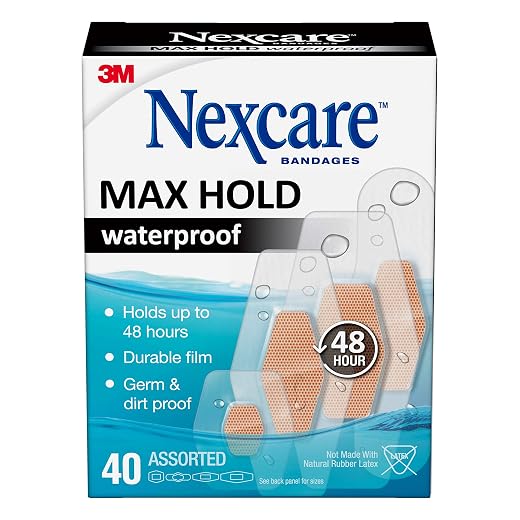
Nexcare Max Hold Waterproof Bandages, Contours to Hard-to-Fit Places, Like Heels, The Hand, Knees, and Fingers, Assorted Sizes, 40 Count

BAND-AID Brand Water Block Tough Adhesive Bandages, All One Size, 20 Count | Durable Waterproof Protection, Sterile Wound Care for Minor Cuts, Scrapes &...

CURAD Plastic Waterproof Adhesive Bandage for First Aid, Stays on in the Pool, Holds for 12 Hours, Bandages for Fingers & Elbows, Sterile,1 x 3 Inches, 100...
Features
| Brand Name | Medline |
| Item Form | Strips |
| Global Trade Identification Number | 00888277367183 |
| Number of Pieces | 100 |
| Item Shape | Rectangular |
| Number of Items | 100 |
| Recommended Uses For Product | Minor cuts, scrapes, and wounds; Protection from dirt and germs |
| Manufacturer | Medline Industries Healthcare |
| Unit Count | 100 Count |
| Target Use Body Part | Skin |
| Manufacturer Contact Information | 1-800-633-5463 |
| Model Number | NON25670Z |
| Manufacturer Part Number | NON25670Z |
| ASIN | B075KKLGGQ |
| Size | 1 x 3 Inch |
| Product Style | Adhesive |
| Sterile | Sterile |
| Material Type | Plastic |
| Material Features | Waterproof |
A waterproof film matters, but the edges decide whether it survives the day.
A small cut on a knuckle can lose its cover before breakfast: one sink trip, a sweaty workout, dishwater, or a sudden rain shower, and a corner begins to lift. “Waterproof” is not a single performance standard.
Staying power comes from the whole build: a flexible backing that moves with skin, an adhesive that seals around the perimeter, and a pad that does not wick water beneath the film. Fit matters just as much. Oils, lotion, damp skin, body hair, and a bandage stretched across a joint can undermine even a robust design. The stronger options balance a secure seal with enough give to avoid peeling when fingers bend.
Match the bandage to the job
What separates a watertight seal from a quick peel
Each option was compared after wetting, drying, and repeated finger movement—not simply by whether its surface repelled water. A dressing can look sealed yet admit water when an edge wrinkles, catches, or loosens at a knuckle.
Grip after water exposure and edge lift at joints carried the most weight. Flexible adhesives that conform without pulling taut tended to keep a more even perimeter seal.
Waterproof film and plastic backings shed water more readily than fabric, which can absorb moisture and stay damp. Film can be less forgiving on creases, however, so flexibility matters as much as water resistance.
Pad size and placement were checked against the backing, along with transparency, visibility, assorted shapes, count, and pack convenience. A large pack is useful only when its sizes suit the fingers, palms, and joints being covered.
Why hand bandages lose their grip
Adhesive strip use and bonding factors
Hands apply a waterproof bandage that stays on during forearm movements.
Knuckle flexion stretches one edge, while the waterproof bandage that stays on protects the other.
Gripping creates shear, and repeated rubbing against handles, gloves, or fabric lifts a corner. A waterproof bandage that stays on helps keep the dressing secure and reduces that lifting.
Fine hair can interrupt contact.
Hand lotion, soap film, sanitizer residue, and dampness reduce the adhesive’s initial bond.
Any of these factors can shorten how long even a well-applied bandage holds.
Geometry matters as much as material. A narrow strip across a curved knuckle has little flat skin to anchor it. Fingertips are harder still: the surface curves in every direction, and the pad’s working area continually meets water and friction. A bandage wide enough to leave a generous adhesive border around the pad generally has more purchase, though edges near the wound still carry less grip.
To start more reliably, skin should be clean and fully dry.
Press the bandage firmly into place, following the product’s application instructions.
On a joint, placement that allows the strip to conform through normal flexion can reduce edge tension.
On a fingertip, a contour-made shape is often more useful than forcing a standard rectangle to wrap.
After application, briefly flex the finger or make a light grip. An edge that immediately puckers or lifts is likely to catch during the next handwash.
A durable clear-film option for active hands
01
Best for active hands, heels, knees, and fingers
Nexcare Max Hold Waterproof Bandages are a balanced fit when handwashing, perspiration, and frequent everyday movement put ordinary strips under pressure. The 60-count assortment pairs a non-stick pad with a clear film surround, creating a broad, sealed-looking cover rather than relying on narrow adhesive tabs.
That construction is especially practical for small cuts, scrapes, and blisters on fingers, hands, heels, and knees—places where water exposure and friction often arrive together. The varied sizes also make the larger pack more useful than a single-shape box for households or active routines.
- Clear film creates a substantial water-resistant seal
- Designed to remain in place through handwashing and activity
- 60-count assortment covers several common placement areas
- Non-stick pad helps avoid sticking to the wound area
- Film edge can feel firmer during removal than a basic strip
- Broad rectangular shapes may wrinkle across deeply flexing knuckles
- Clear backing can make alignment less obvious before application
In brief A strong all-round film bandage for routine wet work and sweat exposure, with enough variety to handle more than one placement challenge. Its secure feel comes with a trade-off: the film can be less forgiving when crossing a sharply bending joint.
For active hands, this is a particularly well-rounded choice: the clear film extends beyond the pad to give water and sweat fewer easy routes under the edge. The claimed hold of up to 48 hours signals a durability-focused design, though real wear still varies with skin preparation, friction, and placement.
It is most convincing on relatively smooth areas and gentle curves. On a knuckle crease or another high-flex point, applying it without tension and allowing extra border contact can matter as much as the bandage itself.
Heavy-duty waterproof protection at an accessible price
BAND-AID Water Block Tough, 20 Count — a practical small-pack standby
This familiar strip format suits the first-aid drawer that sees occasional kitchen nicks, commuting mishaps, and routine handwashing rather than constant replenishment. Twenty individually sized waterproof fabric bandages can be a more sensible buy when supplies risk expiring or going unused before a large assortment is opened. The Dura-Weave material, four-sided seal, and absorbent Quilt-Aid pad target everyday coverage with a substantial, traditional bandage feel. For cuts crossing knuckles, fingertips, or other sharply moving areas, a mixed-shape pack may provide a closer fit than one universal strip size.
- Waterproof Dura-Weave fabric
- Four-sided protective seal
- Nonstick cushioned pad
- Manageable 20-count pack
- One strip size only
- Less tailored for joints
- Fabric can feel bulky
Large pack with a sealed, breathable clear design
Nexcare’s clear 100-count assortment is built for places where bandages disappear quickly: a busy household drawer, shared workplace first-aid cabinet, or a travel kit refreshed between trips. Multiple shapes and dimensions make it easier to choose a narrower cover for a finger or a broader one for the palm, rather than folding excess film into a moving crease. The transparent backing also lets moisture buildup and edge lift show through—useful for deciding when a replacement is warranted. Bulk packs work most efficiently when stock is rotated and used before the labeled dates; see how long sterile bandages last in storage when planning a larger supply.
- 100-count replenishment format
- Assorted coverage dimensions
- Clear film reveals moisture
- 360-degree sealed design
- Clear film can wrinkle
- Bulk stock needs rotation
- Less discreet when moisture shows
A practical bulk option for everyday wound coverage
A bulk pick for splash-heavy routines. CURAD’s 1-by-3-inch sterile plastic strips make sense for homes, swim bags, and first-aid kits that go through bandages quickly. The pool-oriented positioning suits recurring handwashing, showers, and short water sessions; a large supply also makes replacement less of an event when a strip has reached the end of its hold.
- 100-count sterile supply
- Plastic waterproof strip format
- 1-by-3-inch coverage
- Marketed for pool use
- Less conforming at joints
- One fixed strip size
- Soaking can challenge seals
Flexible coverage for hard-to-fit areas and active use
Nexcare Max Hold is the shape-first pick in this lineup: a thin, clear-film bandage designed to wrap and flex around fingers, knuckles, heels, and knees rather than simply cover a flat patch of skin. That distinction matters on hands, where an oversized rectangle can bridge a crease and lose edge contact as the joint bends.
The 40-count listing is presented as an assorted-size pack, but Max Hold is sold in several count configurations. Current box contents, individual strip dimensions, and the mix of shapes are worth checking at purchase; a larger pack may supply more bandages without supplying more of the narrow or small formats needed for fingertips and tight contours.
- Thin film follows curved, moving areas
- Clear finish is relatively discreet
- Non-stick pad helps avoid sticking to the covered area
- Assorted-size format can suit varied placements
- Pack mix can differ by count and listing
- Film strips may be less forgiving to apply than fabric
- A broad strip can still span a knuckle crease poorly
Quick take A compelling option when geometry is the main challenge. Its value depends less on the headline count than on whether the current assortment includes shapes that match the specific placement.
| Wet hold | Transparency | Fit & assortment | Count / kit use | Removal feel | ||
|---|---|---|---|---|---|---|
|
Nexcare Max Hold Waterproof Bandages, 60 Count Hands, knuckles & sweat | Clear film | Assorted, flexible | 60; regular replenishing | Secure film; deliberate peel | View | |
|
BAND-AID Water Block Tough Adhesive Bandages, 20 Count Shower-ready fabric option | Opaque fabric | One size | 20; occasional use | Nonstick pad | View | |
|
Nexcare Clear Waterproof Bandages, Assorted 100 Count Pool days & multiple kits | Clear film | Assorted sizes | 100; stock several kits | Nonstick pad; flexible film | View |
Pack it so it is usable
Individually sealed wrappers matter more than a headline count.
They also keep a few strips clean in a pocket.
The remaining stock can stay in a home kit.
An opened, loose bandage has no comparable packaging protection.
For an everyday-carry first-aid kit, a 20- or 40-count pack consumes less space than a 100-count carton.
Larger options make more sense as refill stock, especially when hand locations call for both narrow and wide strips.
Redundant sizes are useful: duplicates prevent the kit from being left with only an awkward shape.
Keep cartons or a label record for the lot and expiration information.
Follow the maker’s stated storage conditions as well.
A cool, dry drawer generally protects wrappers better than a hot car, damp gym bag, or pool tote.
Periodically check for crushed, torn, or unsealed packets and replace compromised items.
Waterproof Bandages: Common Questions
Why do bandages on knuckles peel off faster than bandages elsewhere?
Knuckle flexion stretches one edge and compresses the other, and gripping creates shear while repeated rubbing against handles, gloves, or fabric lifts a corner—a narrow strip across a curved knuckle also has little flat skin to anchor it.
Does clear film hold up better than fabric bandages?
Waterproof film and plastic backings generally shed water more readily than fabric, which can absorb moisture and stay damp, but film can be less forgiving on creases, so flexibility matters as much as water resistance.
What should I do before applying a waterproof bandage to make it stick better?
Skin should be clean and fully dry, and on a joint, placing the strip so it can conform through normal flexion—rather than stretching it tight—reduces edge tension that leads to peeling.
How can I tell if a waterproof bandage is still sealed after swimming or showering?
Edge lift, especially at corners and near bends, is a more useful signal than the clock; a clear-film design also lets moisture buildup show through so it’s easier to judge when a replacement is needed.
Is a bigger pack always the better buy?
Not necessarily—a large pack is only useful when its sizes suit the fingers, palms, and joints being covered, and a smaller 20- or 40-count pack can make more sense for occasional use or everyday-carry kits where space and expiration matter.
Choose Fit Before Waterproofing
For active hands, Nexcare Max Hold 60 Count is the strongest all-around match where broad edge coverage and frequent washing matter. BAND-AID Water Block suits occasional wet chores, while Nexcare Clear Waterproof 100 Count makes more sense for households needing varied sizes and steady replenishment. CURAD Plastic Waterproof 100 Count is a practical pool-kit option; the Nexcare Max Hold 40 Count format merits attention for contours and tricky placements.
Start with the hand location and a shape that can lie flat through motion; water exposure comes second. Even a capable waterproof film depends on a clean, dry surface, a wrinkle-free adhesive border, and use consistent with the product instructions.


9 Comments
Why wasn’t the Hydro Seal style bandage included? I know it’s more of a blister bandage, but those have honestly survived showers better than regular waterproof strips for me.
That’s a fair question. Hydrocolloid/blister-style products can be excellent for shower protection, but we kept this comparison to conventional adhesive bandages for small cuts and everyday hand-kit use. Their thicker pad, longer wear profile, and removal experience make them a slightly different category.
I was hoping for a true cheap pick. Twenty bandages for the price of a lunch feels steep when you have kids who use one for every microscopic scrape. Are basic water-resistant store brands really that much worse for handwashing?
Thank you for mentioning clean, dry skin before application. Lotion, sunscreen, and flour dust are probably responsible for half the “this bandage won’t stick” complaints in my house.
I’d still like to see a future comparison of sensitive-skin options. Strong adhesive is great until taking it off feels like removing packing tape from a peach.
The reminder to verify the actual assortment is important. “Assorted” can mean useful fingertip shapes, or it can mean 90 strips you’ll never use and ten you actually want. Been burned by that before.
I appreciate that you didn’t pretend clear film is magic on every joint. A bandage can be perfectly sealed on the back of my hand and then immediately curl up when it’s right over a finger crease.
The “fit before waterproofing” takeaway is probably the most useful part of this. People blame the brand when they’re using a straight strip in the worst possible spot.
The 100-count clear assortment makes sense for a family kit, but I’m skeptical about stock rotation. Who is realistically dating their bandage box? 😂 I do agree that old wrappers in the bottom of a car kit are a bad idea though.
Any reason the 40-count Max Hold is listed separately from the 60-count? Is it exactly the same bandage in a smaller box, or can the mix of sizes change? Pricing is all over the place where I shop.
The core Max Hold design is the reason both pack sizes appear, but pack configuration and assortment can vary by retailer and listing. That is why we recommend checking the package’s size breakdown rather than assuming the count alone tells you what is inside. If the price per usable strip is close, the 60-count is generally better for an active household; otherwise the 40-count may be the less wasteful choice.